The problem
Life doesn't leave room for consistent study. So most people cram.
Preparing for a course, an entrance exam, or an interview takes steady practice over weeks — but a packed schedule usually collapses that into a few frantic nights before the deadline. Studying alone in that mode rarely sticks. And generic AI chat doesn't help: it hands you an answer, which isn't the same as understanding you've actually earned.
The mechanism
It guides you there. Then it makes sure it stuck.
Guides you, doesn't just answer
Hint
Think about what each message proves, and to whom. What does message one prove?One more nudge
Right. After the server replies, does the server actually know the client got that reply?Here's the answer
Fair — here it is: the server can't be sure the client's alive until it hears back one more time. That third message is the missing confirmation. Two messages leave the server guessing; three closes the loop both ways.Then makes sure it stuck
Teach it back
Before we move on — explain, in your own words, why the induction step needs the base case at all.Not quite
Getting there — the base case is what anchors the whole chain to something you've actually proven, not assumed. Try again.Nailed it
Nailed it. That's the difference between reciting a proof and understanding one.The routine
And it helps you actually show up.
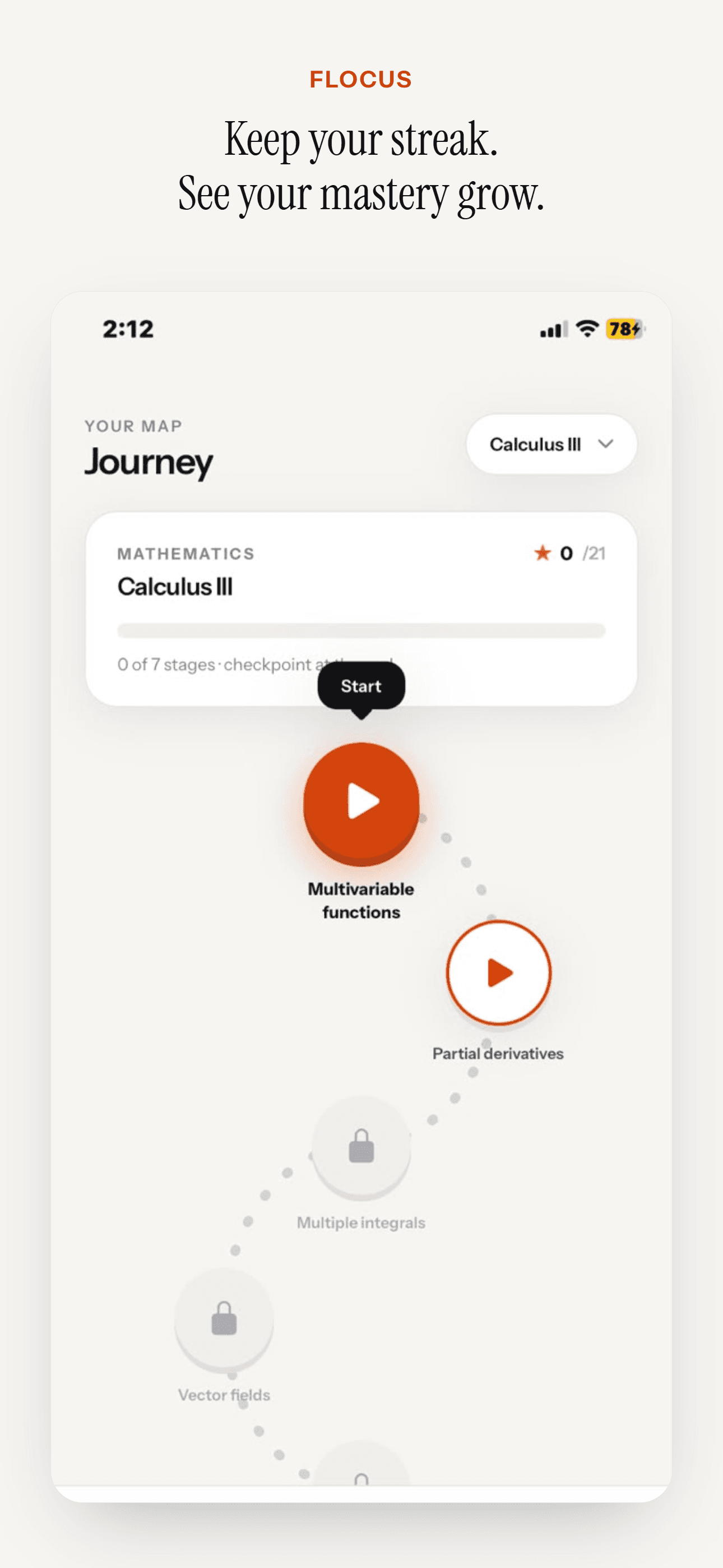
A streak isn't app opens — it's a session you actually kept. Missing a day doesn't erase the streak; it just makes tomorrow matter a little more.
7-day streak — milestone reached
Research suggests a specific plan for when you'll study beats a vague intention to get to it eventually.
The nudge
And gives you a reason to come back.
At most one nudge a day — timed to when it actually helps, not just to get you to open the app.
Don't lose your streak
A quick session tonight keeps it alive.
Recall check due
A few topics are due for review.
Pick back up?
Right where you left off — no judgment.
What's coming
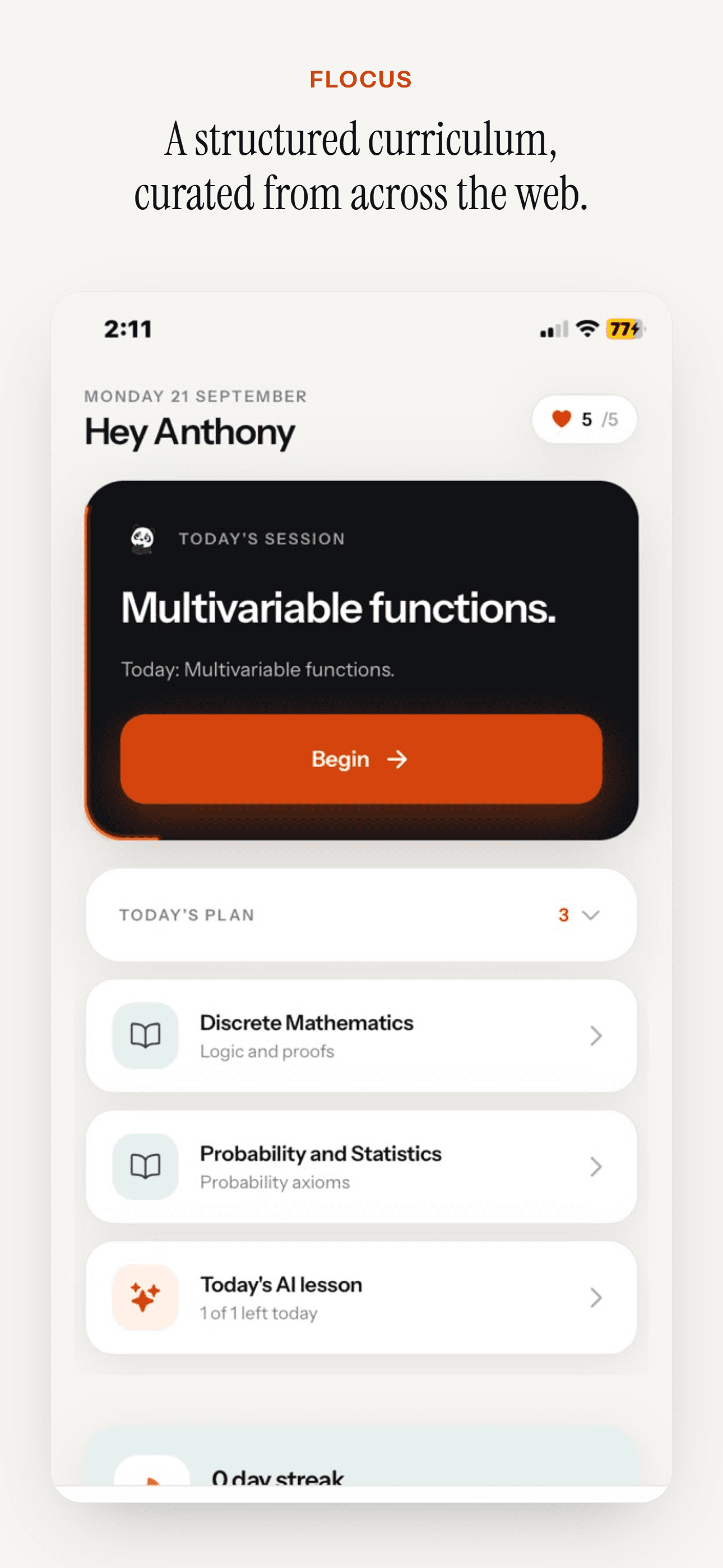
Everything is built around actually learning it.
Teach-back tutoring
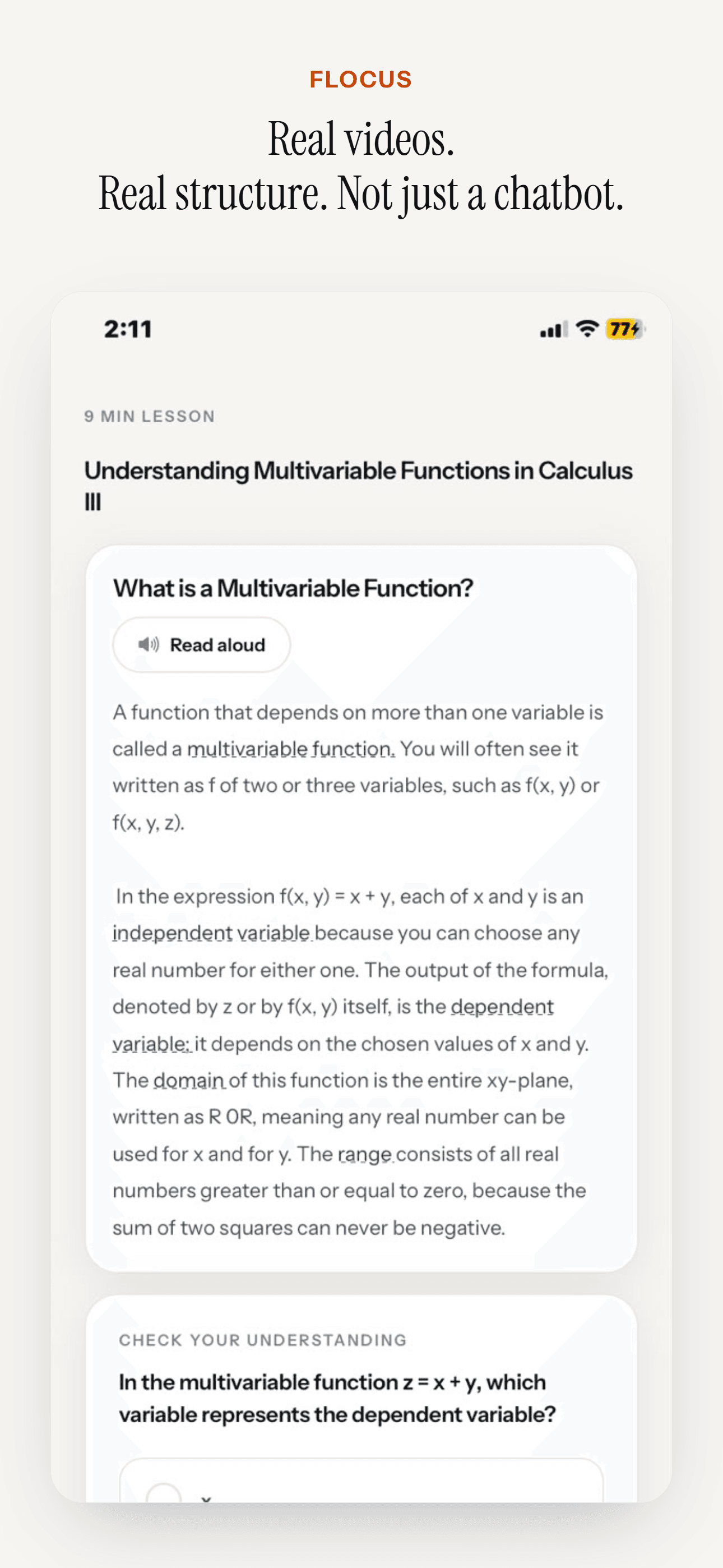
Flocus doesn't just answer. It asks you to explain the concept back in your own words before moving on — the same thing a good human tutor does.
Learn more →Spaced practice
Concepts resurface right before you'd forget them, not on a fixed calendar — spacing your review is proven to beat cramming.
Learn more →A profile that learns you
Flocus tracks how you learn best, what's worked for you, and what's worth double-checking — and adjusts pacing accordingly.
Learn more →Photograph a problem
Stuck on a question in a textbook or problem set? Snap a photo and talk it through with your tutor.
Learn more →A routine that gamifies itself
Streaks, milestones, and a visible sense of progress toward your goal — so showing up doesn't rely on willpower alone.
Learn more →The real thing
Not a mockup. This is what's on your phone.
Why this works
Built on how memory actually works, not vibes.
Real tutoring, not just chat
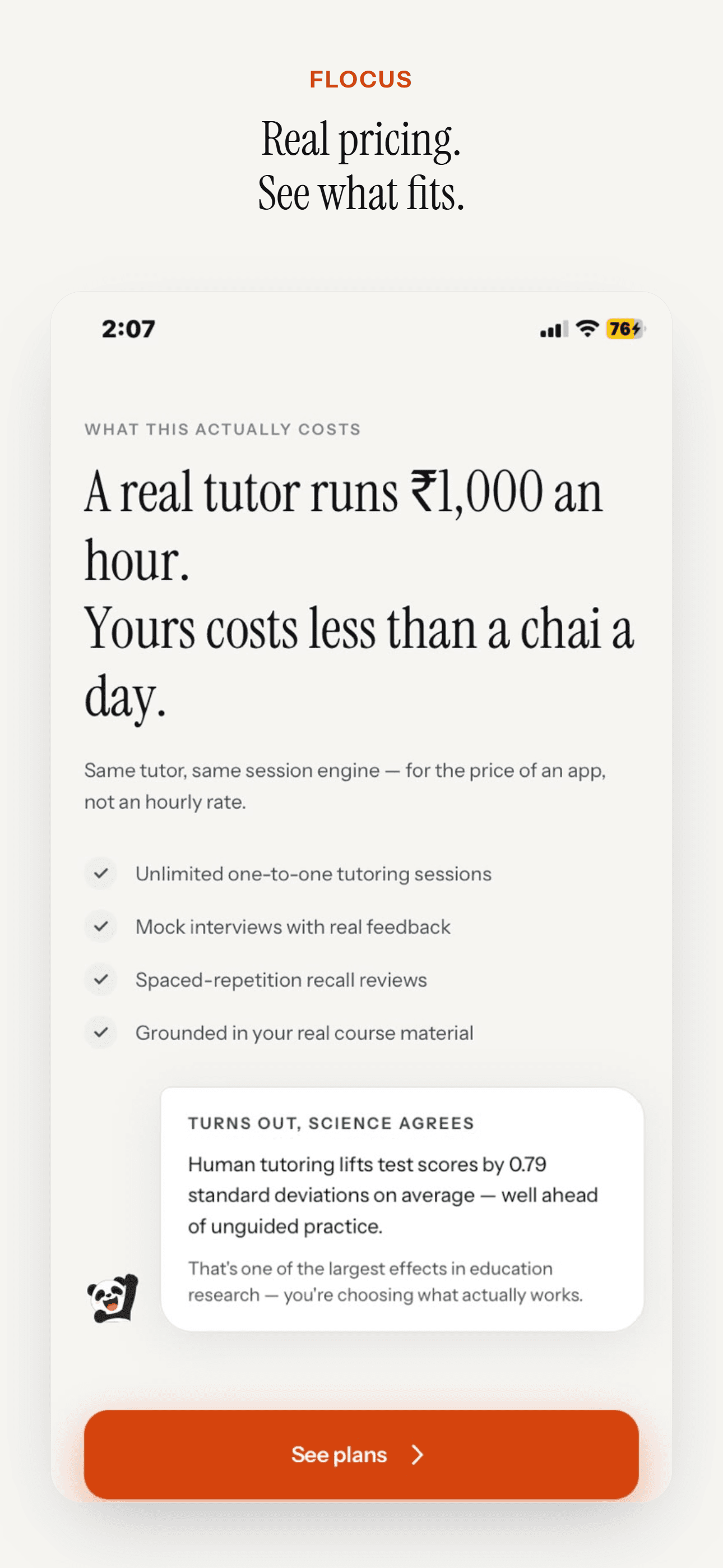
Research on human tutoring keeps finding the same effect, whether it's a classroom or a study session at a kitchen table: a real tutor beats studying alone by a wide margin.
Spaced review
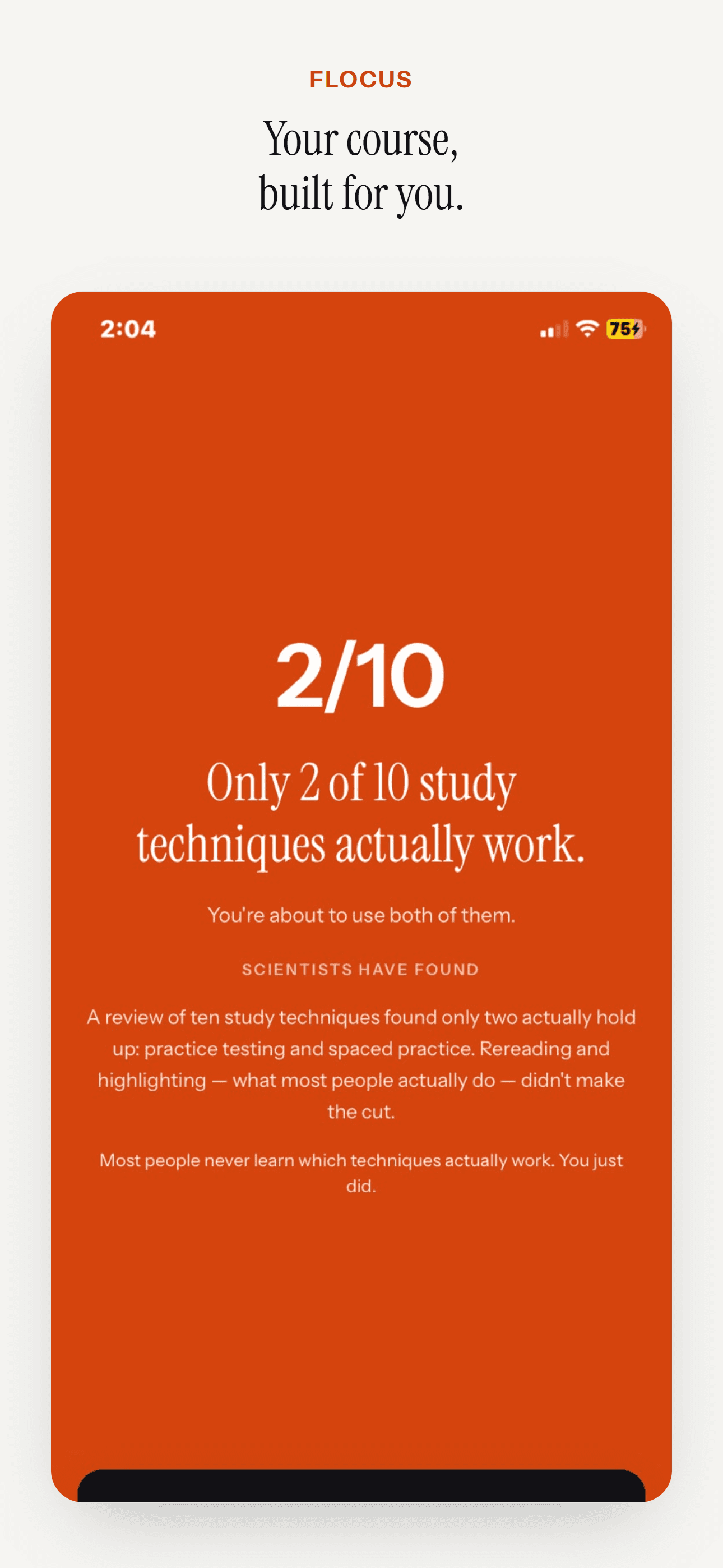
Spacing practice out over time consistently outperforms cramming for long-term retention, according to decades of research.
Retrieval > re-reading
Being asked to recall or explain a concept, instead of just re-reading it, produces stronger, longer-lasting memory, a well-established finding in learning research.
Teach-back
Explaining a concept back in your own words is one of the most reliable signals that you've actually understood it, not just recognized it.